Saturday, December 27, 2008

The DRB is Open!


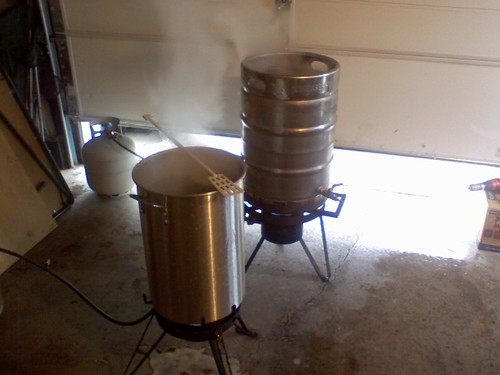
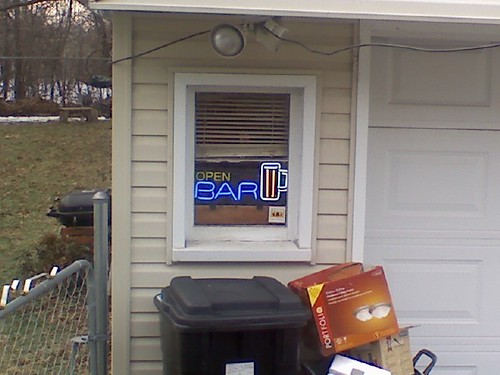
Whenever the DRB opens for an evening, quite a few of my friends receive the text message "the drb is open!".. This usually leads to people coming by throughout the evening sampling whatever beer is on tap that night. Thanks to my neighbor, the DRB now has an open sign. It's almost like my garage is an official bar now.. haha. I'm really anxious for it to get dark. I'm kind of hoping you can't see the sign from the street..that's all I need is for strangers to start showing up!

For the record, tonight is the first ever UFC pay-per-view event in the DRB. The English Mild is now on tap, which turned out pretty good. It's a low 4% with a mellow nutty flavor to it. Turned out pretty perfect, and right close to the style guidelines for this beer. I think it's time for another! I made venison sliders for tonight and breaded venison steak bites. We have a handful of people coming over, so it should be a good time. It's an awesome 63 degrees out right now, I'm not even sure we'll need heat out there tonight! See you @ the DRB!

Thursday, December 25, 2008

Winter Classic 2009 @ The DRB

Yes folks, the first ever, outdoor Detroit Redwings hockey game in Chicago will be live (on t.v.) @ Dayton Road Brewing. There should be a couple good beers on tap and some snacks. This is the first and probably last in our lifetime Wing fans get to enjoy this unique hockey event. Be there!!

Monday, December 15, 2008

Weather report: A mild day


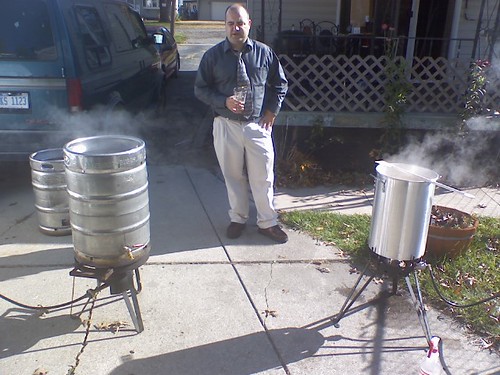
I thought it was funny the weather reporter kept saying Sunday, December 14th is going to be a "Mild" day. Funny because I brewed my first English Mild yesterday, along with the brown. I always figure, if I'm going to brew a batch of beer, I may as well do two - since I'm dirtying everything up and going through all the work. I actually planned to do 10 gallons of the brown ale, and use 5 for the bourbon oak batch, but I kind of f'd up the recipe and only bought enough for a 5 gallon. doh!

So, here's the recipe for this one:

7 lb. Maris Otter
2 lb. 2-row (toasted in oven)
1/4 lb. chocolate
1/4 lb. crystal 120
.10 lb. black patent (darken the color up some)
hops: 1.2 oz of Kent Golding 5% AA - this actually brings it just out of the BJCP style of this beer, being it's over the alpha acid range for this style, but, I figured I was already over in the gravity - so I tossed them in. :)
OG: 1.051

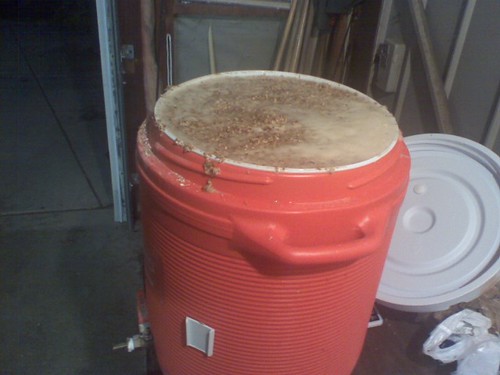
I also used dry yeast on this one, the DCL S-04 Safeale. I thought I'd give it a try, it's amazingly cheap @ 1.99 a pack. I just checked on both beers and they're starting to ferment - no bubbles yet, but the brown ale has a foam formed on top of it, which is always the start of fermentation. Had I done the starter with liquid yeast, this sucker would be rolling fermenting by now.

I also kegged the christmas ale yesterday. I had like 2 1/2 gallons left in a carboy sitting there chilling out waiting for the holidays to come. And, with my new 3rd keg, I kegged the remaining 5 gallons of the Blonde ale. We have a work party on the 19th, which every year usually spills over to the DRB - I plan to give out samples of the Christmas ale, and pints of the blonde. :) Thankfully, no one reads this blog from work, so I'm sure people won't come specifically to get their pint of blonde ale. haha.

Anyhow, it was a good day for brewing. It was surprisingly warm, which made it much easier running back and forth to the house for water or whatever. Oh yeah, and in case you're wondering - English milds are typically a very low ABV beer, they range from 2.5 to 3.5 abv. Here's a brief history on the style:

--Mild Ales originated in coal mining regions of England and Wales. Mild Ale was intended as a low alcohol beer for heavy consumption by miners and as a harvest time drink for farm workers. They are often the least expensive beers available. Mild Ale is sweeter and lighter colored than Porter. It is as malty as possible in a low gravity beer. This style is most common in the West Midlands of Great Britain. It had been declining as a style due to a perception as old-fashioned. It now seems to be making a comeback. Mild refers to bitterness not flavor. They can be full of flavor whether light or dark. English Light Mild Ales range from light amber to light brown in color. Malty sweet tones dominate the flavor profile with a little hop bitterness or flavor. Hop aroma can be light. Very low diacetyl flavors may be appropriate in this low-alcohol beer. Fruity ester level is very low. Chill haze is allowable at cold temperatures. --

So I decided to bump the gravity a bit. The extra base grain brings this mild up to a 4.9 to 5%. The final gravity actually is in the range of this beer style. I was right on with the color, as far as the style goes.. so, it'll be a good close example to what the miner folks drank.
Saturday, December 13, 2008

Bourbon oak english brown


I'm doing a crazy one here folks. This is a southern english brown ale style. My original plan was to do 10 gallons of brown, and split it up. Keg one as a brown ale, and rack the second to sit with some bourbon soaked oak chips. Only, my brain wasn't working right this morning, and I planned out the perfect 5 gallon recipe - but was thinking it was a 10! Oops. So, life goes on - I'll just have to whip up another batch soon, to keep the beer flowing in the D.R.B. :)

8lb maris
4 lb victory
.50 crystal 40
.50 crystal 120
.50 biscuit
.50 chocolate

.87 oz. kent goldings - 5% (20 IBU's)

OG: 1.062 (a bit high for this style, but I want it up there a bit more since I'm adding the oak/bourbon).

Yeast: This'll be my first time trying dry yeast. I'm going to use Safeale S-04. Also soaking oak chips in bourbon for a bit to add to the secondary. Can't wait to see how this one comes out. I'll report back in the comment section on how this went. I think I'm going to brew on Sunday (tomorrow).

Wednesday, November 26, 2008

Snow Shovel Blonde


Not too long ago, someone asked me "have you ever brewed a normal beer?".. I had to sit back and think about what they meant by "normal".. To me, an IPA is pretty normal, or the Porter I just put on tap. Those are about as normal to me as beer gets. But I thought about it, and a "session" type beer came to mind. I read through some books and dug around on the internet and found Blonde Ales to be one of those more normal type beers. Here's what Wikipedia has to say:

Blonde ales, also called golden ales range in color from that of straw to golden blond(e). They are clear, crisp, and dry, with low-to-medium bitterness and aroma from hops, and some sweetness from malt. Fruitiness from esters may be perceived but do not dominate the flavour or aroma. A lighter body from higher carbonation may be noticed. The lightness in the use of hops and malt can make blonde ales a good introduction to craft industry beers for consumers only familiar with mass-marketed beers.

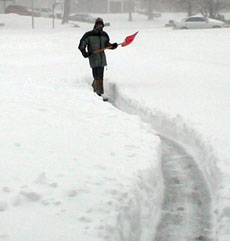
So basically, I'm making a lawn mower beer in the middle of winter! I figure by the time this is on tap, I'll be shoveling snow. My thoughts drifted back to last winter. I woke up on a Saturday morning to about a foot of snow. I threw on some boots (and clothes if I remember right), and first things first, stomped through the snow to the garage (DRB) and turned on the heat. I knew after shoveling, I was going to need a day of r&r. I spent a couple hours shoveling. My neighbor was out supervising his kids shoveling, which also wore him out. We retired to the garage where we enjoy a few (several) pints of homebrew and played a couple rounds of chess.

By the time we get hit with a big snow, I'll be ready. I don't plan on bottling this one, I think it'll all go straight to keg. Here's the recipe:

23 lb. American 2-row
1 lb. Crystal 20
2 oz. Willamette 5% AA (beginning of boil)
Yeast: White Labs California Ale (starter)
OG: 1.050 / FG: 1.011 - 5.2% (though my program has me coming in at a 1.060 OG, 6%)

Can't get any easier than that. I did some preparing last night. I made my starter with DME this time (I had been using LME), and boy what a difference that made. I didn't get any boil overs. I just checked it and there's already activity starting.
I also milled the grains last night and brought my hot liquor tank in as well as my mash tun, to keep them at room temp. Not much else to do but fire up the strike water and get this brewday going!

Thursday, November 6, 2008

Porter & Christmas Ale

Porter:
11.75 lb. 2-row
1.5 lb munich malt (only I didn't use munich - see below)
1 lb. crystal
.75 lb chocolate malt
.5 lb black patent

Hops:
60 minute Kent Golding 5%AA - 1.75 oz.
15 minute Fuggles 5%AA - .75 oz.
0 minute Kent Golding - 5%AA - .75 oz.

Yeast:
White Labs London Ale (starter)

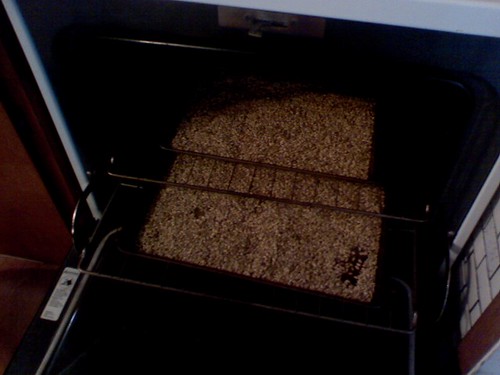
I realized last night that I didn't have any Munich grains. I forgot to get them last time I was at the homebrew store. I did a post on Beer Advocate asking for advice. Some said to just up the 2-row, the Munich isn't necessary. One guy, at like 3 in the morning posted, saying to try toasting the 2-row to make something a bit similar to a Munich. I'm not sure if he was right or wrong, but I didn't feel like driving to Dundee. I threw a couple pounds onto a cookie sheet and put them into the pre-heated oven for 15 mins, more like 20. I stirred them every few minutes. My house smelled amazing. When they were done, I tasted them then tasted the regular non-toasted. Big difference. I hope it adds a nice toasty flavor to the beer.. we'll see!
The base for this recipe came from Brewing Classic Styles book.
OG: 1.072

========================================
Christmas Ale
12 lb. two row
1 lb. crystal
.25 lb. black malt

Hops - 1 oz. Horizon - 13%AA 60 min.

Yeast:
White Labs London Ale (starter)

The grain and hops are pretty close to the same as the recipe in Brewing Classic Styles. I used my smaller mash tun for this one and it worked well. The beer came out looking like a brown ale and smelling sweet.
OG: 1.074

(spices to come later)
========================================

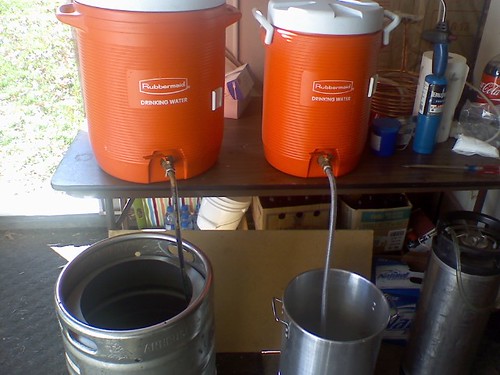
The day went pretty well. Jason at Adventures in Homebrewing suggested trying to keep a layer of water on the grains when you sparge at all times. I had previously been draining the wort all out - then sparging. He explained when you do that, the water doesn't get to travel through all of the grains, it creates almost like tunnels for the water to travel down, since the grains became so compacted from the first sparge out. So, I did it that way this time and it seemed to go well. I ended up with about 7 gallons of Porter (pre-boil) and about 6 gallons of the Christmas Ale. The boil went well, a couple of boil overs on the Christmas Ale (I need another keg boil tank!).
Excellent day for brewing too, 74 degrees today!! Aaron stopped by and supervised brewing for a while.
After I was finished brewing I kegged and bottled my Hop Head IPA. So far it tastes wonderful, nice and hoppy. By Saturday I should be able to kick back and have a pint to see how it is cold and carbonated.

Monday, October 20, 2008

Extract efficiency calculations

I've always been curious about my extract efficiency. I dug around and read several articles about it. A lot of them are just flat out confusing. I found a pretty basic one, that explains the breakdown like this:

1. Multiply the amount of grains you used by the potential maximum extract from your grain. You can find them online, here's a list of some popular grains (click here), I didn't see my Maris Otter on there, so I just googled "maris otter extract potential" and several sites came up.

2. Once you have these numbers, multiply them by the amount of grains you used. So, with my most recent IPA i brewed, here's the breakdown:
20 lb Maris Otter x 38 = 760
4 lb Munich x 37 = 148
2 lb Crystal x 34 = 68
===============================
976

3. Take this final number, and divide it by the number of gallons of wort you collected, in my case, I collected exactly 12 gallons. 12/976 = 81.3 points

4. Next, and this part is tricky, but bear with me: Take your specific, pre-boil gravity number, mine, was 1.072. Take the last two numbers, and and divide your total points from step 3 by this. So: 81/72 = 88%

I'm guessing this is how it's done. After reading several articles, I think I have this all together right. Correct me anyone, if this is wrong.

But 88% sounds pretty good to me. I was wondering how I was doing in this area. I know there are a lot of factors that can effect the efficiency. Using a refractometer, crushing the grain better, proper sparging temperatures, etc. Here's a thread with some interesting tips on boosting your extract efficiency - (click here).